

Introduction
Accurate measurements are at the heart of every architectural project. From floor plans to renovations, measuring tools for architects have evolved dramatically — from tape measures to advanced laser measuring systems. But not all solutions are equally practical. Depending on the stage of the project and the accuracy required, architects now have a wide range of options, from simple 1D devices to powerful 3D systems, and more recently, highly efficient 2D scanning tools.
From 1D to 3D — and Back to 2D
Laser technology first entered the construction and surveying field with 1D laser distance meters. These tools quickly replaced the tape measure for everyday tasks, offering single-point accuracy in seconds.
Surprisingly, the next big leap wasn’t 2D but 3D laser scanning. The market introduced sophisticated 3D systems first, capable of capturing millions of points to create highly detailed spatial models. These tools are extremely powerful — but also heavy, expensive, and data-intensive. Keep in mind that the post-processing required for 3D scans can be very time-consuming. Because of their high cost, some suppliers offer rental options so you can test the equipment before committing. It’s always wise to try before you buy, and experience the full workflow — from scanning to processing — to see if it truly matches your needs.
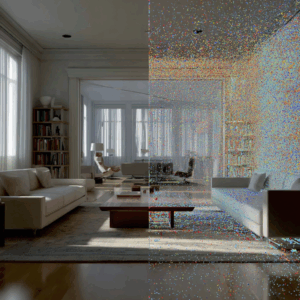
The gap in 2D became clear later. Architects and engineers realized that for many interior projects, a 2D laser scanner was not only sufficient but often the most practical choice. Today, 2D devices have matured significantly, combining multiple scans into one accurate floor plan with far less complexity than 3D systems.
Why 2D Scanning Fits Architectural Needs
Architects usually measure buildings during early stages — often when a house is still under construction, an empty shell, or undergoing renovation. At this point, a polished 3D visualization doesn’t necessarily help them present the finished design. Instead, they need precise floor plans and angles to build upon.
Meanwhile, real estate agents, for example, benefit from 3D or panoramic scans, but they don’t require the same level of precision. Architects, on the other hand, demand higher accuracy to ensure drawings, layouts, and construction plans are reliable. Yet the extensive post-processing of 3D scans often feels unnecessary for this stage.
That’s where 2D scanning stands out:
Practical floor plans: Generate accurate layouts quickly.
Compact files: Much smaller than 3D point clouds, easier to store and share.
Cost-effective: More affordable equipment compared to 3D scanners.
Faster workflows: No heavy data cleaning or modeling required.
Multi-position stitching: Modern 2D systems can merge scans from multiple spots, delivering complete and precise plans.
An extra advantage: On-site clarity
With 2D scanning, architects can immediately verify wall alignments, angles, and room proportions on-site — reducing costly mistakes later. This immediate feedback is one of the most underrated but practical advantages over 3D.
Choosing the Right Measuring Tools as an Architect
When selecting architectural measuring tools, consider:
Stage of the project — early construction vs. finished presentation.
Accuracy required — design precision vs. visual marketing.
Time available — how quickly you need usable data.
Budget and complexity — balancing cost with real needs.
For many architectural projects, 2D laser measuring strikes the perfect balance between accuracy, speed, and practicality.
Conclusion
Measuring tools for architects have come a long way, but progress isn’t always about adding complexity. While 3D systems are precise, they produce huge files, require heavy post-processing, and often go beyond what’s necessary for day-to-day architectural work.
Despite the wide variety of devices available, most architects have not invested in advanced measuring machines because they remain extremely expensive. Many still rely on 1D laser meters combined with diagonal measurements. With effort, repeat visits, and occasional errors, this method can get the job done — but it is becoming increasingly impractical now that affordable 2D scanning tools exist.
This is exactly the vision behind the 2d scanner: to offer the next step in laser measuring — accurate enough for the majority of architectural needs, faster, more practical, and cost-effective. For many professionals, 2D scanning is not just the middle ground between 1D and 3D, but the right-sized solution that saves time, reduces errors, and delivers reliable floor plans without unnecessary complexity.
At 2DScanner, our mission is to simplify the daily work of professionals who need precise interior mapping. We provide a practical, easy-to-use tool that delivers accurate results at an affordable price — with no hidden costs, extra software, or subscriptions. Want to see how it works? Visit our YouTube channel, check out our FAQ, or dive into our help documentation. With 2DScanner, you pay once and scan forever.