

What Is Indoor Mapping?
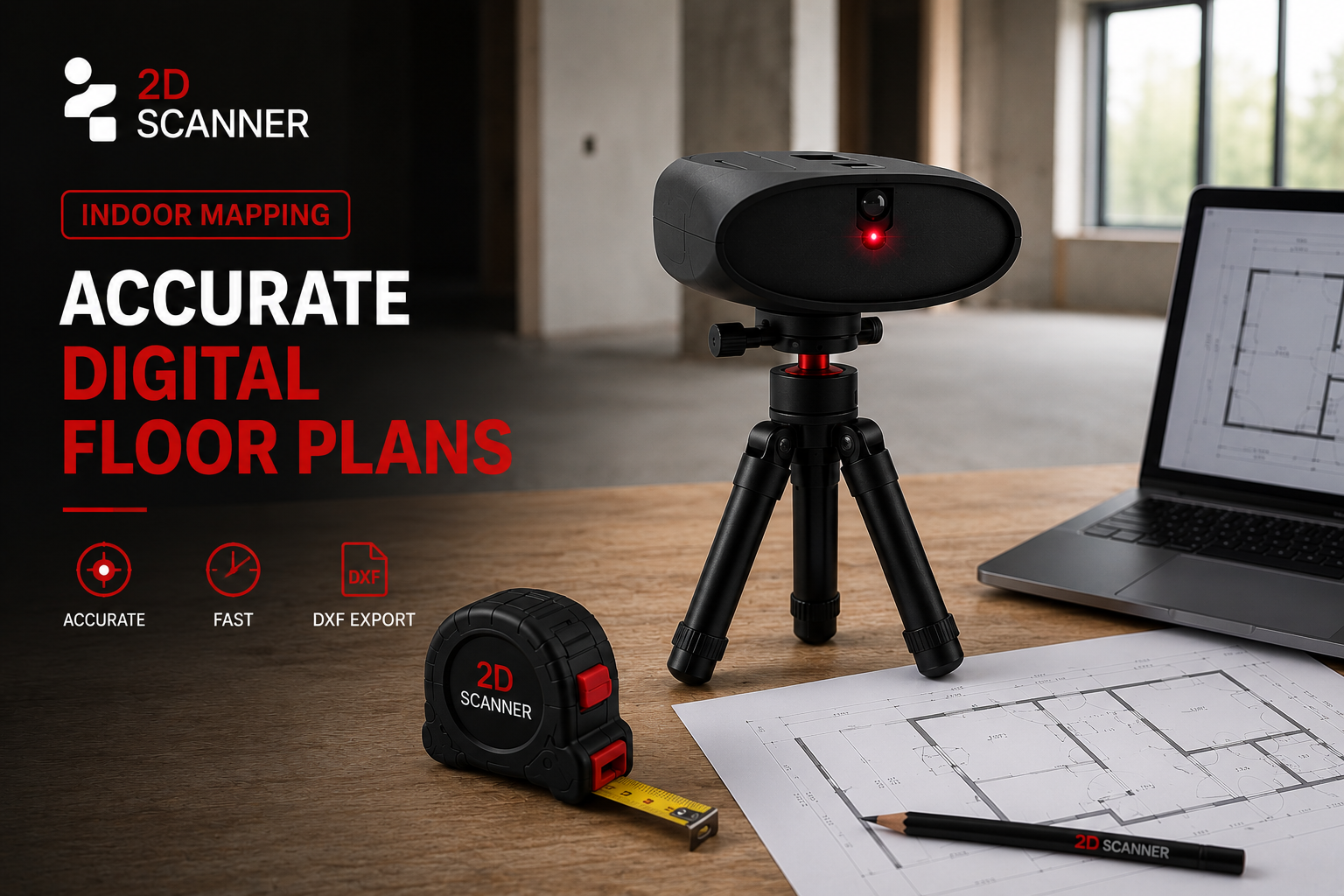
Indoor mapping is the process of digitally scanning and documenting interior spaces using advanced measurement technology.
Unlike traditional measuring methods, indoor mapping systems collect spatial data in real time and generate accurate digital representations of rooms and buildings.
Modern indoor mapping technologies can capture:
- Room dimensions
- Wall geometry
- Angles and corners
- Door and window openings
- Structural irregularities
- Interior layouts
The collected data can then be processed into digital floor plans and CAD-ready files for technical workflows.
Why Accurate Digital Floor Plans Matter
Accurate floor plans are critical for every stage of construction and renovation projects.
Even small measurement mistakes can create major problems during:
- Furniture installation
- Kitchen fitting
- Material cutting
- Electrical planning
- Plumbing work
- Drywall installation
Digital floor plan scanning helps contractors avoid these issues by improving measurement consistency and reducing human error.
How Indoor Mapping Improves Floor Plan Scanning
Indoor mapping technology provides a faster and more reliable alternative to manual measurements.
Instead of relying on hand-written notes and manual sketches, contractors can scan entire spaces digitally and generate detailed floor plans with significantly improved accuracy.
Faster Data Collection
Indoor mapping systems dramatically reduce on-site measuring time.
Large rooms and complex layouts can be scanned much faster compared to traditional methods.
Better Accuracy
Digital scanning minimizes human error and captures precise room geometry.
Improved Workflow Coordination
Digital floor plans can easily be shared between:
- Contractors
- Architects
- Engineers
- Interior designers
- Installers
This improves communication and reduces project misunderstandings.
Reduced Project Delays
Accurate floor plans reduce installation issues and costly rework.
The Role of 2DScanner in Indoor Mapping
Modern devices such as the 2DScanner EVO help professionals simplify the floor plan creation process by combining digital scanning with practical construction workflows.
The 2DScanner EVO is designed to help contractors and technical professionals:
- Capture accurate room measurements
- Generate digital floor plans
- Improve renovation planning
- Reduce manual measurement errors
- Export DXF-compatible files
- Work faster on-site
By using indoor mapping technology, professionals can improve both project speed and accuracy while reducing costly installation mistakes.
The ability to export CAD-ready floor plans also makes it easier for teams to collaborate during construction and renovation projects.
Digital Floor Plans and CAD Workflows
One of the biggest advantages of indoor mapping systems is the ability to create CAD-compatible floor plans.
Modern scanning systems allow professionals to export:
- DXF files
- CSV data
These file formats are commonly used in:
- AutoCAD
- Architectural software
- Engineering applications
- CNC workflows
- Furniture manufacturing
This allows contractors and designers to work using accurate digital measurements throughout the entire project lifecycle.
Improved Accuracy in Complex Spaces
In real construction environments, walls are almost never perfectly straight, and room corners are rarely true 90-degree angles. Because of this, contractors often face serious challenges when trying to achieve highly accurate measurements using traditional methods.
Additionally, plaster swelling, wall curvature, uneven surfaces, and hidden structural irregularities make manual measurements even more difficult. As a result, measurements collected on-site may not accurately represent the true geometry of the space.
Moreover, the common diagonal measuring method used by many professionals is problematic by definition. Even when the diagonal appears correct, it is still extremely difficult to calculate real room dimensions accurately because curved walls and surface imperfections affect the final result.
Consequently, small errors of just 3–5 mm on every diagonal can accumulate throughout a project. Over time, these inaccuracies can lead to significant installation problems, especially in cabinetry, carpentry, kitchen fitting, and custom furniture manufacturing.
Therefore, contractors increasingly rely on advanced digital scanning solutions to improve precision and reduce costly mistakes. This is exactly where the 2DScanner EVO becomes a major advantage for professionals who demand accurate room measurements using a single practical tool.
Why Digital Workflows Improve Project Efficiency
Furthermore, digital floor plan scanning improves workflow coordination between contractors, engineers, architects, and installers. Since all project teams can work using the same digital data, communication becomes faster and more reliable.
In addition, CAD-ready DXF exports simplify technical planning and reduce the possibility of production errors. Because of this, indoor mapping technology is becoming an essential part of modern renovation and construction workflows.
Common Applications of Indoor Mapping
Residential Renovations
- Contractors can quickly scan homes before renovation work begins.
Commercial Construction
- Large commercial spaces can be measured more efficiently.
Kitchen and Cabinet Installation
- Accurate measurements reduce production and fitting errors.
Interior Design
- Designers can work using real room dimensions and layouts.
Property Documentation
- Digital floor plans improve property management and real estate presentations.
Challenges with Traditional Measuring Methods
Time-Consuming Processes
- Manual measurements require multiple checks and repeated calculations.
Human Error
- Hand-written notes increase the possibility of inaccurate dimensions.
Difficult Room Geometry
- Irregular walls and curved spaces are difficult to measure manually.
Communication Problems
- Paper sketches often create confusion between project teams.
Indoor mapping technology helps solve many of these challenges by providing accurate and shareable digital data.
Why Contractors Are Adopting Indoor Mapping Technology
Construction workflows are becoming increasingly digital.
Contractors are adopting indoor mapping systems because they help:
- Improve measurement accuracy
- Save time on-site
- Reduce project delays
- Improve collaboration
- Create reliable digital documentation
- Reduce installation problems
For contractors looking to improve measurement accuracy and project efficiency, digital floor plan scanning solutions offer major advantages.
Learn more about floor plan measurement services for contractors.
Contractors can also explore how digital scanning workflows improve floor plan creation accuracy in renovation and construction projects.
The Future of Indoor Mapping and Digital Scanning
Indoor mapping technology continues to evolve rapidly.
Modern digital scanning solutions are becoming faster, more portable, and more accurate.
As construction and renovation industries continue adopting digital workflows, indoor mapping will become an essential part of:
- Renovation planning
- Construction documentation
- Technical installations
- CAD workflows
- Digital project management
Professionals who invest in digital floor plan scanning technologies today will be better prepared for the future of modern construction workflows.
FAQs – Frequently Asked Questions
What is indoor mapping?
Indoor mapping is the process of digitally scanning and documenting interior spaces using advanced measurement technology.
How does indoor mapping improve floor plan accuracy?
Indoor mapping captures detailed spatial data and reduces human error compared to manual measurements.
What industries use indoor mapping technology?
Construction, architecture, interior design, engineering, real estate, and renovation industries commonly use indoor mapping solutions.
What is the benefit of digital floor plan scanning?
Digital floor plan scanning improves speed, measurement accuracy, workflow coordination, and project efficiency.
Can indoor mapping systems export CAD files?
Yes. Most modern systems export DXF and other CAD-compatible file formats.
How does the 2DScanner EVO help contractors?
The 2DScanner EVO helps contractors capture accurate room measurements, generate digital floor plans, and improve renovation workflows.
Why are digital floor plans important in renovation projects?
Digital floor plans help contractors detect irregular room geometry and reduce installation mistakes.
Can digital floor plans be used in AutoCAD?
Yes. DXF floor plans can be imported into AutoCAD and other CAD software platforms.
What are the limitations of traditional measuring methods?
Traditional methods are slower, more prone to human error, and less efficient for complex spaces.
Why are contractors switching to indoor mapping technology?
Because it improves accuracy, reduces project delays, and helps teams work more efficiently using digital workflows.
👉
Read more about the 2Dscanner,
Check in action on our YouTube channel,
or visit the FAQ section.
